
The current cost-of-living crisis in Australia weighs down the simplicity of dying with paperwork, financial restraints and barriers to end-of-life services. (Image: Amelia Hegarty)
By Amelia Hegarty | @amelialhegarty
Death is polite. We can see it. We can hold it. A tangible object in our hands in the form of a loved one who is cold to touch, who is aged by illness.
Yet, we struggle to admit when someone is dying. Including me.
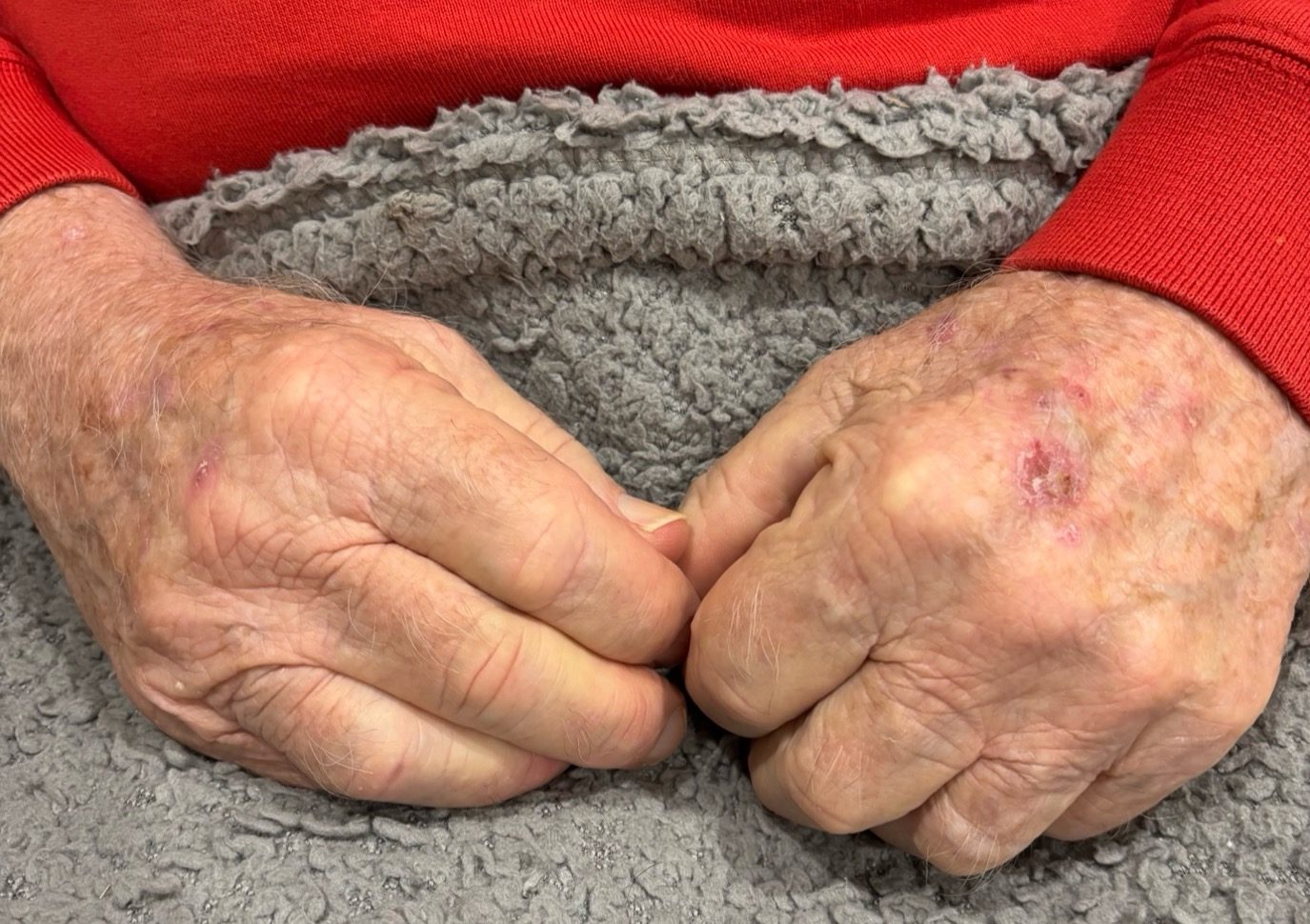
I see death in the pale skin of his arms. They look almost paper thin. I see it in the pained movement of his body. I hear it when he groans as he stands or sits down. And I feel it when he leans his whole weight on me for stability as he moves.
For someone who doesn’t know about his diagnosis, my grandfather’s limited movement could be mistaken for the general ageing and aching of an 80-year-old body.
By the time he was formally diagnosed in 2025, it was a week between finally finding an answer to his symptoms to being told he only had months to live – a year and a half at most.
Like many other older Australians, my grandfather is navigating the end-of-life process.


Images: Amelia Hegarty
And like so many other Australians in palliative care, my grandfather is only just realising that the cost of dying is not cheap and it’s not easy.
He was diagnosed with multiple system atrophy (MSA) and is already starting to experience the symptoms of this rare, progressive neurodegenerative disorder.
Brain Foundation categorises this disease as the degeneration of certain nerve cells in the brain and spinal cord. The areas of the brain that are affected will soon result in a dysfunction of movement and motor control.
This includes difficulties with balance and mobility, impotence or incontinence, and dizzy spells.
Soon, my grandfather will no longer be able to swallow, talk and walk. He will become confined to his bed as eventually his brain will lose the ability to tell its body how to move.
There is no cure for this disease and there is no known means to slow the progression of it either, Brain Foundation states.
Like my grandfather, individuals diagnosed with MSA enter into palliative care and wait for their body to stop cooperating.
In a report conducted by the Australian Institute of Health and Welfare, there were 109,059 individuals in need of palliative care in 2024.
Of this population, the report states 96 per cent “received Specialised Palliative Care (SPC) or other relevant service in the last year of life”..
Only 62 per cent actually received SPC; services which include inpatient hospital care, out-patient clinics and Medicare-subsidised services.
“We know there are barriers to accessing timely palliative care for a range of communities,” says Chief Executive Officer for Palliative Care Australia, Camilla Rowland.
“This … data paints a more detailed picture of who is missing out.”
Rowland states that while it is important to remember not every individual with a terminal diagnosis requires SPC, it is the ability to access and understand palliative care that needs to be improved.
The need for palliative care continues to grow with the ageing population of Australia.
The Australian Bureau of Statistics (ABS) found that in 2024, 65 per cent of deaths occurred in people over the age of 75 and dementia accounted for 9.4 per cent of deaths in 2024, becoming the leading cause of death in Australia.

Source: ABS, Cause of Death, Australia (2024).
After his diagnosis, my grandfather sought out ways to manage this process.
“When I realised what I had, and then realised that I did need special [assistance], I got involved with the government on a home care package… called Silver Chain,” he says.
“It can be very confusing with all the forms that have to be filled out,” my grandfather says. He credits my grandmother for her support in assisting with the paperwork side of palliative care.
“Luckily, I’ve got a partner that’s filled forms out all her life and that’s made it easy.
“If someone was entering into end-of-life care and didn’t have that support, it may not be so accessible or affordable,” he says.
Alongside Silver Chain, my grandfather also joined the Mary Potter House at Calvary Hospital. Both Silver Chain and the Mary Potter House are not-for-profit providers that assist and support people living with a life-limiting illness.
Executive Director of the Mary Potter Foundation, Kristen Hardy, credits her team and the charity for “bringing moments of joy” to patients in hospice and their families.
“We listen to the patients and find out what is important to them and then we try and make it happen,” she says.
Hardy believes, like SPC, the non-clinical services provided by the foundation could assist in prolonging life; some services include pet therapy, music therapy, life stories program, family dinners and more.
“It’s individualised care that we’re helping to provide … in that hospice environment.
“It’s about being there and supporting them during a challenging and vulnerable time,” she says.
Like Hardy, end-of-life doula, recreational therapist and funeral celebrant, Briget Kelly sees the benefits to palliative care in Australia but also sees a possible struggle to keep up with this ageing population.
As a small business owner in Adelaide, Kelly offers non-clinical service in end-of-life care to individuals and families navigating this process.
During a time in someone’s life where support is needed most, Kelly helps her clients to not only manage the “bureaucratic” side of dying but the emotional side as well. She was motivated to work in the business of dying following her own experiences with caring for family members.
“They have to make some pretty big decisions in a pretty big hurry…they’re just completely overwhelmed,” she says.
She is also aware of the cost that comes with dying and the consideration of how much it will cost to access services or to find further support.
The Department of Health, Disability and Ageing states palliative care expenses are largely covered by Medicare. Private health insurance may also cover costs including home nursing and GP visits.
However, some costs are not covered.
Unexpected bills can come in the form of medicines, specialised equipment for use at home or private health professionals such as psychologists and physiotherapists.
Kelly’s personal experience of caring for her sister showed her how costs can sometimes be the difference between life and death.
“I supported [my sister] when she first was diagnosed with cancer. They said you’re going to have to take this drug, kind of quite a new immunotherapy,” Kelly says.
“We found out it wasn’t on the PBS [Pharmaceutical Benefits Scheme]… it was phenomenally expensive…
“My sister was on a low income; she just didn’t have that [finance]. So, then she was thinking ‘well, I’ve only got one treatment option, and I can’t afford that’.”
Following her sister’s experiences and the formation of her small business as an end-of-life doula, Kelly embraced the community and the opportunity to learn more on dying.
Two and a half years ago, Kelly says she was lucky enough to receive a scholarship to attend the Oceanic Palliative Care Conference.
She says it was a validating experience where she could share her understanding on end-of-life care but also learn more from others in the industry.
Kelly found a common note of admission that “resources are stretched” and a recognition that the palliative care system is “not as good as it needs to be”.
The financial strain of end-of-life care is what Kelly describes as a “postcode lottery”.
“It does often come down to where you live, as to how well you’ll be supported…
“Some places you may get much better service because there’s just more resources there than other places where there’s less resources or because you don’t fall into the right age to get… funding,” Kelly says.
Financial Planner at Poynter Hargraves Wealth, Craig Hargraves, offers financial advice to individuals who may be experiencing end-of-life care. He also assists with retirement, non-ordinary and insurance advice.
Hargraves sees the convoluted side of dying, as clients seek his services to put their financial affairs in order before they pass.
Similar to Kelly, he sees the barriers that come with a postcode as he says the whole system is very difficult.
“It is very common for us to see that [with] Centrelink… where they’ve tried to do it themselves but the whole system is very difficult, very rigid, and people do find it easier to get advice to navigate through that at times.”
He believes the greatest injustice comes when his clients try to ignore the impending timeline and “stick their head in the sand”.
With the complex process of dying, it seems there isn’t much downtime to grieve before you need to start planning for the end.
He sees the emotional side of dying with his clients and tries to offer support as much as he can to make the end-of-life process easier.
“What we try to encourage people to do is [understand] you don’t have to be an expert in everything,” he says. “The biggest problem is you don’t know what you don’t know.”
Going to a financial advisor could allow for further income to support someone going through end-of-life care, Hargraves surmises.
He says with this process, he helps clients find where to put their money prior to their death, and teaches them how to plan for tax and minimise the cost for family members.
This consideration is significant to his clients especially following the ever-increasing cost of a funeral.

Source: Australian Seniors, The Cost of Death Report 2.0 (2023)
In a report published by Australian Seniors, the cost of death is high as funerals averaged at $9,076 in 2023. Burials cost significantly more than cremations and increase the price on average to $11,039 compared to $8,045 for cremations.
“Close to nine in 10 feel as though funerals are getting too expensive these days,” says Australian Seniors.
The report finds a general consensus of mixed feelings on whether the expense is worth it – 40 per cent felt conflicted on this and three in 10 felt pressure to spend more on a funeral than they wanted.
While financing a funeral can leave a large hole in one’s wallet, a high ratio of people still feel the effects long after. On average, one in three people experience financial hardship as a result of paying for a funeral and one in five are yet to fully recover.
Adelaide local, Jo Newham is the one in five. Following two funerals and one end-of-life care plan, she is still navigating the financial cost of dying.
Newham lost both her parents in the span of 12 months to terminal illness. Her father passed as a result of cancer and her mother to Alzheimer’s disease.
While the outcome was not unexpected due to her parents’ elderly age, she still looks at the experience with an overwhelming exhaustion for how difficult it was to undergo as a carer.
Her father passed quite quickly between his diagnosis and his decline.
Her mother did not. While she was fortunate to have that extra time with her mum, Newham continues to feel confused and unable to grasp the end-of-life care process.
She credits the support she had from her sister who undertook the role of first executor and enduring power of attorney. This meant her sister would take the financial “reins” when it came to making decisions for their mother.
Newham’s mother was in palliative care for a couple of years. Due to the slow decline of her mother’s health, Newham found she could no longer care for her mother at home.
This admission felt like failure as she moved her mum into a facility that was better equipped to assist with end-of-life and aged care.
What Newham didn’t expect were all of the hidden costs that came with supporting a family member who was actively dying. And it wasn’t just the formal costs for care that came into it but the ones that are so often overlooked.
“Suddenly, it’s almost a full-time job for somebody [to care], to be driving, sleeping over.”
Even with her mother living in a nursing facility, Newham’s professional life was impacted as she continued to take her mother to external GP appointments.
Going to see specialists could take half a day between driving to the clinic, waiting hours for the doctor and then driving home.
It took time away from her career.
“It’s not as if we didn’t know that there were probably some carer options… but it seemed too big of a mountain to climb to be finding more information…” Newham says.
Between paying for petrol, her mother’s medication and the nursing facility, Newham says she feels she wasn’t prepared for the out-of-pocket costs or the toll it would take on her and her sister’s wellbeing.
“It nearly ruined both of our health – her [sister’s] mental health and my physical health. And your relationships, your work. It affects everything in your life.”
When her mum passed, Newham expresses feeling relief. She was relieved her mum was no longer in pain.
Again, there was no downtime to fully grieve as she had a funeral to plan. It was recommended Newham and her sister go to a financial advisor as well as a property lawyer to settle the finances, execute the will and sell their parents’ home.
For the financial support, Newham says it costed between $5,000 and $10,000. Again, the cost was unexpected but Newham believed it would all be coming to an end.
It meant time for her to grieve properly and not have to think about what else needed to be paid orwho else needed to be taken care of.
It meant time to experience guilt, relief and sadness, she says. It meant she could take care of herself now.
It has been four months since her mother’s passing and while the large proportion of handling the legal side of dying is over, every now and again, Newham says she and her sister have to sign a legal document or attend a solicitor meeting.
“Despite having had the financial support and all of that sorted from the beginning… [there’s still another] meeting with another solicitor to finalise this [and that]…” she says.
“It hasn’t quite finished yet.”
As my grandfather moves into the final stages of life, like Newham’s mother, he struggles to live without assistance.
His family continue to promote routine and normality in his life, to prevent feelings of isolation and burden.
He maintains strong friendships and frequent catch ups with loved ones; every Tuesday is family pub night where he enjoys garlic prawns amid the hustle and bustle of a vibrant bistro.
Despite our efforts, my grandfather struggles with the removal of his independence and strength.
“Sometimes I sit in this chair we have at home, and I just look out the window for hours. And just look at nothing,” he says.
“It’s not that I don’t think ‘Gee, I wish it wasn’t me’. Of course, I do… but I accept that I can’t change it.”
For my grandfather, dying is not easy. It’s just accepted.
It’s messy and difficult and can be made all the more stressful when handling financial and legal affairs at the same time.
Dying is emotional.
When did death become some complicated?
Dying is a shared and innate human experience. With barriers preventing easy access and affordability to necessary services, there are those that fall through the cracks.
And dying is made that much harder to process.


Leave a Reply