
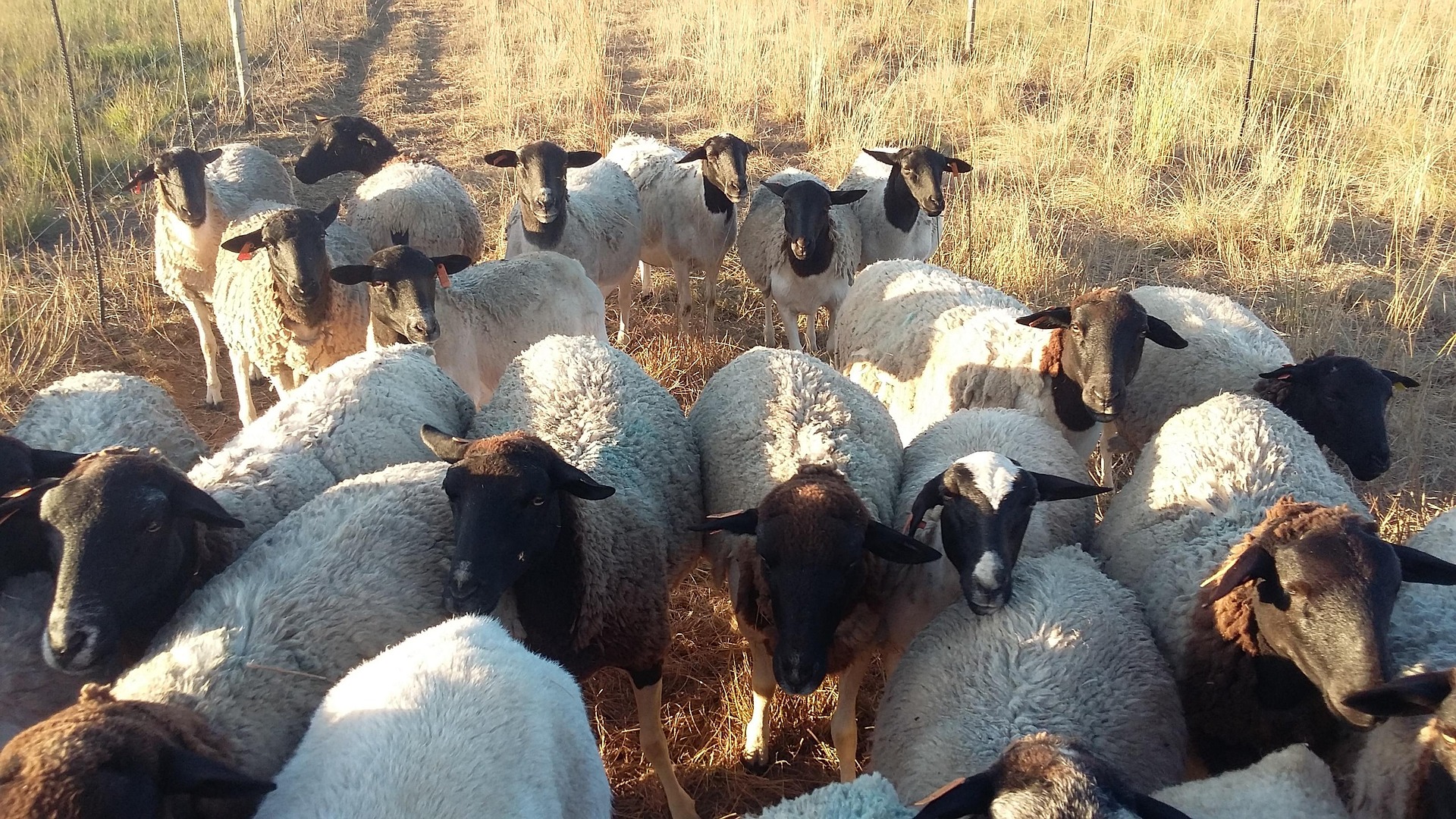
Wool used to be Australia’s main export, but amid a cost-of-living and environmental crisis, many producers are turning to the sheep that doesn’t need shearing. (Image: Dollatjie)
By Mia Handley | @miajh1428
Australia once rode on the Merino sheep’s back.
There were rows of shearers in black tank tops and grey workers’ pants, dragging sheep along the weathered wall of the shed.
Flies buzzed in their ears, a dim light peeking through the rusted holes in the tin ceiling.
To the soundtrack of humming cutters, the shearers peeled away thick fleeces, exposing the pure white underneath.
For much of Australia’s history, this ride seemed limitless — but now, it’s slowly dying.
The Australian Wool Production Forecasting Committee predicts 243.9 million kilograms of shorn wool in the 2026/27 season, just 23.2 per cent of the peak in 1989.
Yet while one industry is struggling, another has taken its place.
Darren Old has been a stock agent for 20 years, acting as an intermediary on behalf of farmers to buy and sell livestock and supplies.
He believes that wool is a “niche product” unlike red meat — a shift that is reflected in Australia’s export numbers.
While wool is steadily declining, in May 2025, Australia’s lamb export value exceeded $4 billion over 12 months for the first time.
Old believes that the Dorper sheep is a major contributor to this change.
“Merino breeders have tended to have to spoon-feed their sheep a little bit … where Dorpers-wise … they can live on rougher tucker for longer, and [farmers] can keep their sheep,” he says.
The Dorper is a South African breed that quickly attracted producers due to its high fertility, hardiness and meat quality.
For farmers facing rising costs and drier seasons, the Dorper offers an alternative to hiring shearers — the breed naturally sheds its wool.
This change is already apparent, as experts in June 2025 predicted one-in-five shearers would leave the industry by December because of declining Merino numbers.
For the shearers who remain, adaptation is critically important.
‘We’re just flying around like a little butterfly in the wind’
Down the main street of Strathalbyn, behind the local swimming pool and along the river, is shearer and Find My Crew director Tom Hutton.
The Angus River Reserve is unusually warm for May, so the sky is clear and blue, and Hutton waits with two large cups of coffee.
He’s wearing the merchandise of his app, Find My Crew, that connects farmers to labourers across the country, while also assisting with ABNs, insurance, super and payments.
Through a marketplace-like system, farmers can list jobs and hire labourers, including, but not limited to, shearers.
“Dorpers are picking up a bit … [but] a lot of shearers got less work. It’s hard to make a living out of it now,” he says.
“Shearing is not 12 months of the year; it’s eight months to 10 months … if you can find the work and it’s getting less and less now … I just started to get a bit bored,” he says.

Hutton at Strathalbyn’s Angus River Reserve. (Image: Mia Handley)
Hutton believes the sheep industry still has a lot to offer newcomers.
This past season, he helped one of his ewes give birth in a paddock after he noticed her struggling to push her lamb out.
“I guess it happens with humans, like in a hospital, but it’s very clinical, and you don’t see any of that process … we’re disconnected with everything,” he says.
“[I] just want to connect people … [my app] is the gateway, you know?”
After his brother passed away, Hutton was pushed to act. He and his partner sold their property in Finniss, packed their belongings into a caravan, and invested all their money into Find My Crew.
“It was hard to juggle the finances and stuff like that … I was still grieving, I guess. I guess that never goes away. You learn to live with it,” he says.
While the app was initially designed to focus on shearers, Hutton has since expanded the concept to other farming jobs. He aims to make them more accessible.
“Farmers can post just little jobs, and it might just be like a day or two, but it might suit these people travelling. It might pay for the fuel for the week,” he says.
“We’re sort of just flying around like a little butterfly in the wind. I don’t know which way it’s gonna blow next.”
‘We were going to drown’
While the need for shearers has decreased, fifth-generation New South Wales grazer Justin McClure believes Dorpers have changed sheep farming for the better.
Three days a week, he’s in his 1963 silver-and-red vintage aeroplane, soaring over his property, Kallara Station, and the Darling River.
When McClure is in the skies, below him stretches a painting of the typical Australian outback: rust-red soil and pale river silt, swirled around a spattering of sheep.
“[One girl] wants to pay me for helping her build hours for a commercial [pilot] license. There’s no need for that. You just come and work for me, and we’ll make it happen,” he says.
Originally established in 1857, Kallara Station was one of Australia’s biggest sheep runs, spanning approximately 1,000,000 acres and shearing over 400,000 sheep.
While now smaller in size, the NSW outback property still operates as a sheep meat and cropping farm, also offering accommodation and farm stays.
In McClure’s words, if his family had not decided to switch to Dorpers, his farm wouldn’t have survived.
“We had to bite the bullet [and switch to Dorpers], or we were going to drown. We were going to go under. We were going to have to sell up and go and do something different,” he says.
McClure switched from Merinos in 2002 after joining a group of six producers, facilitated by the government and the Australian Wool Innovation.
The group’s analysis of their economic situation was the “catalyst” for McClure’s change to Dorpers.
“We’ve got a little saying in our family that ‘We hold this land in trust for our children,’ … and if we wanted our children to have the same opportunity that we had … it was not a hard decision,” he says.
“The average age of the average Australian farmer is about 65 or something ridiculous. But the pathway it was on, it was to be about 85.”
This age change has also been noticed by Deepdale Dorpers farm manager Brady Bowen.
“Some young fellas are going back on the farm … whereas before it was kind of like, ‘Well, you can’t come back because we can’t afford to have you here’, you know?” he says.
Deepdale Dorpers is a stud located in Merrinee, Victoria, that breeds Dorpers. The owners, James, Luke and Patrick Hardwick, lease Bowen’s family farm from him.
“The passion isn’t lost with the wool or Merinos … [but] it just doesn’t work anymore … the price of [farming] was double what they used to pay, but the returns weren’t there,” Bowen says.
“We don’t need as many shearers as we needed 20 years ago … [but] those guys aren’t unemployed … they’re landmarking Dorper lambs, they’re doing fencing.”
Bowen believes that the technology movement growing with Dorpers will help farmers “run more sheep on the same amount of land”.
Deepdale Dorpers utilise a database to track the pedigree, or family tree, of their sheep, preventing interbreeding and tracing genetic mutations that harm the quality.
“It’s natural selection, but it’s technology selection,” Bowen says.
For stock agent Old, he’s noticed Dorpers are getting “better and better”, and yields are getting “higher and higher”.
“The first load of lambs I hooked back when I started in Ouyen was about $3.20 to $3.50 a kilo … and now, you know, you’re getting $11 and $12 a kilo,” he says.
Lamb prices have hit historic highs across Australia, driven by strong saleyard prices and demand despite poor seasonal conditions.
Old hopes that once Dorper meat is bought by the supermarkets, farmers will be able to compete with white meat, Australia’s most popular protein.
“You can buy a charcoal chicken every day of the week, and every chicken looks the same. If we can do that with every lamb … then we know we’ve made it,” he says.
‘Everything starts as a seed’
As a cross between the Dorset Horn and the Black Head Persian, the original goal of the Dorper was to create a sheep with the adaptability of a South African sheep, but the meat quality of a European breed.
Both are rewarded in Australia, as farmers across Victoria and NSW are currently fearing they face drought conditions like those of 40 years ago, which killed an estimated 86 million sheep.
At Kallara Station, McClure is no stranger to the harshness of the Australian climate; his property fluctuates between extremely dry and completely flooded.
Sustainability is a major factor in his approach, and he recently joined the NSW Biodiversity Conservation Trust, setting aside 7600 hectares of his property for conservation.
“[The money] gives us the ability to invest in more infrastructure to manage our land more sustainably. It just lets us work the country with a softer touch,” he says.
McClure says responsible Dorper farming involves rotating sheep through different paddocks to allow the grass to recover and working with Aboriginal people in farming operations.
“By changing into Dorpers, it gave us the opportunity to still be there on the land, and it gave us the ability to protect our land,” he says.
Back in Strathalbyn, Hutton believes farmers must adapt to new situations and technologies — something his app hopes to continue.
“You see these little seeds grow into these big plants. Everything starts as a seed. That tree there would have started as a tiny little seed,” Hutton says.
He points to a gum tree that stretches into the sky.
For McClure, he believes the Dorpers have created an environment where it has never been better for young people to get involved in the agricultural industry.
“You can do 20 different jobs in the day, and not all of them are enjoyable, but … at the end of the day, yeah, you can have a cold drink and enjoy the community hub,” he says.
“We are [Australia’s] skin. We wear it like a glove, and that’s why we love what we do.”
If you or someone you know needs help, contact:
Lifeline: 13 11 14
Beyond Blue: 1300 22 4636
Kids Helpline: 1800 55 1800


Leave a Reply