
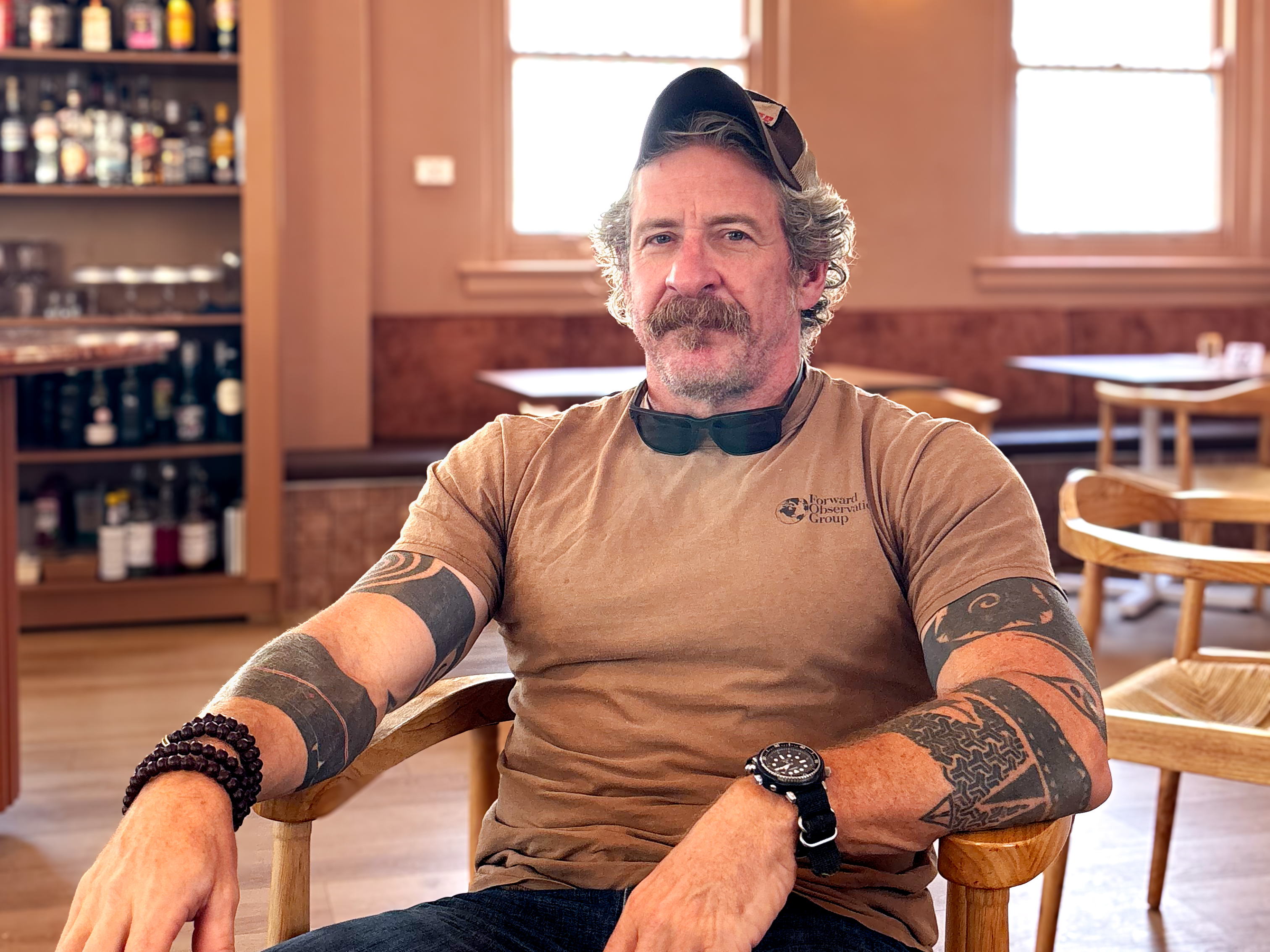
On July 9, 2009, former military soldier and private security contractor Rob Langdon was arrested for murder. He was sentenced to death by hanging. Almost 20 years later, Langdon has swapped the prison cell bars of Pol-e-Charkhi for picket fences in Adelaide. (Image: Amelia Hegarty)
By Amelia Hegarty | @amelialhegarty
For seven years, Rob Langdon’s normal was a six-by-eight-foot cell in what he categorises as the “seventh circle of hell”.
Normal was surviving by submitting to an all-consuming rage and fighting to see tomorrow.
His normal was thinking the only two ways out of Kabul’s infamous Pol-e-Charkhi prison were death or external political instability leading to his pardon.
“… push comes to shove; I’m going to get out.”
Normal life for Langdon was so very abnormal for everyone else.
Having served 15 years in the Australian Defence Force (ADF), he eventually moved into the private defence sector in 2004 and worked as a security contractor in Iraq, South Africa and Afghanistan.
Langdon was familiar with this life. He was familiar with the structure that so often came with enlistment and private contracting.
“I’m used to sleeping in the dirt and getting shot at,” he says.
But it was during his employment as a contractor for private security company, Four Horsemen in Afghanistan that Langdon faced a death sentence.
Following an urgent phone call from two co-workers who had been hit by a rocket-propelled grenade while on a convoy mission south of Kabul, Langdon was asked to assist with protection.
It was never a split decision to aid his co-workers, despite resigning from the company.
“Although I had quit Four Horsemen a few hours earlier, I could not walk away from this,” he says.
And upon arrival at the convoy that was stuck in place and susceptible to attack, Langdon approached the road-watcher — the person who would go ahead via vehicle and scout to make sure the road was clear — to figure out why there was a delay.
The ex-soldier has always maintained his innocence. He has always stated he acted in self-defence.
“I was arrested on Thursday 9th July 2009. On Wednesday, I’d quit my job, killed a man and set his body on fire,” Langdon recounts in his autobiography, The Seventh Circle.
Even now, he tries to separate the past from the present and to remove the concept of “what if.”
What if he hadn’t walked up to the road-watcher who had been armed and aggressive towards fellow co-workers?
What if he hadn’t acted on instinct and shot the road-watcher who had waved the gun in his face?
“[What] if only I’d done this different?” he wonders.
The sequence of events that followed saw him arrested, imprisoned in one of Kabul’s worst prisons and sentenced to death. For seven years, Langdon lived in uncertainty, consumed and protected by his rage.
Survival was on a day-to-day basis. There were no guarantees on if he would see tomorrow.
“… all I have got to do [is] just get through today,” says Langdon. “And that’s what I did.”
As Langdon sits down across the table in a small café on Woodville Road, he positions himself to see the entrance to eliminate any blind spots.
To the unaware individual, Langdon almost looks normal. That is, if you overlook his towering height, his concrete-like stature and his imposing presence. Thick bands of ink wrap around his arms, somewhat symbolic of the mental constraints of his imprisonment in Kabul.
To see him now in such an ordinary context blurs the reality of his past experiences.
For Langdon, life now contains “still a certain amount of novelty,” he says.
“This is so far from what I’m used to.”
Langdon’s partner, Susan Strachan, credits his attempt to ease back into society, saying that while he may not always be successful, he tries.
“I don’t think he can fully transition from that military background or that prison experience back into… real life,” she says.
Since his pardon from Pol-e-Charkhi in 2016, Langdon has attempted to regain his version of normality after years in hell.
He discusses the quick turnaround of his pardon and how it went from hours of thinking he might be released a few years early to being released immediately.
With the help of international human rights lawyer Kim Motley, Langdon was pardoned and released. And with the removal of the physical bars that contained him, he still finds the mental ones a restraint in his life.
“Once I got out, I started doing the same thing because that’s all I knew and that was the easiest way to cope with all this other bullshit that real life sort of has,” Langdon says.
Following his release, Langdon found catharsis in writing down his experiences, and in 2017 he published his autobiography, The Seventh Circle.

A copy of The Seventh Circle by Rob Langdon. (Image: Amelia Hegarty)
He credits how “anger was [his] armour” throughout the book. It was a shield that protected him physically from the other inmates and mentally from the idea that he had been let down by his former employer, Four Horsemen.
It’s no surprise the question that comes to mind as we sit opposite each other is: how are you so normal? How are you so composed?
“Define normal,” he says.
“It’s taken a bit to get through this, and this is where I’ve come out the other side.”
Langdon says his experience in conflict as a soldier in the ADF meant he was familiar with counselling and therapy — a health and well-being service that is mandatory for soldiers coming back from war.
These outlets were recommended to him as a way of adjusting from one life to another post-release from prison.
“At first, I actually caused more problems for one of the therapists when I was in South Africa. She just didn’t know how to deal with some of the shit,” he says.
“Then I saw another one when I got back who was on the east coast … she worked a lot with guys who get out of jail in New South Wales … she spent time in the … medical corps of the South African defence force [as a psychologist].
“She knew exactly where I was coming from. She’d seen hundreds of young guys who’d been through similar, if not worse things from the old days.”
He recognises his anger lying just beneath the surface but finds the gym a useful outlet for burning off the excess “fuel”.
“It bubbles time and time… going to the gym helps a lot. Having something to do helps a lot,” he says.
Now, Langdon lives in Adelaide with Strachan and her two children. Strachan creates a space in which she accepts his past and acknowledges his challenges.
“He understands his mental health, he understands the challenges he faces… he’s learning,” she says.
Not only does Langdon find solace and control in the gym, but he also finds strength in leaning on his friends and comrades from his time in the army, he says.
“It’s knowing that they’re there,” Langdon states. “You can ring up any of these guys you haven’t seen in 10 years.”
He calls his current life an accident, albeit a happy one, and while he did not mean to fall in love and settle in one place, Langdon lives a life that is abnormal to him.
“Sometimes it doesn’t [feel real].”
For Langdon, hell on Earth became a reality, and for seven years of his life, it became his version of normal.
Despite violence, death sentences, and the uncertainty of whether he would ever leave that jail by walking out, Langdon is adamant that he would still not change a thing.


Leave a Reply