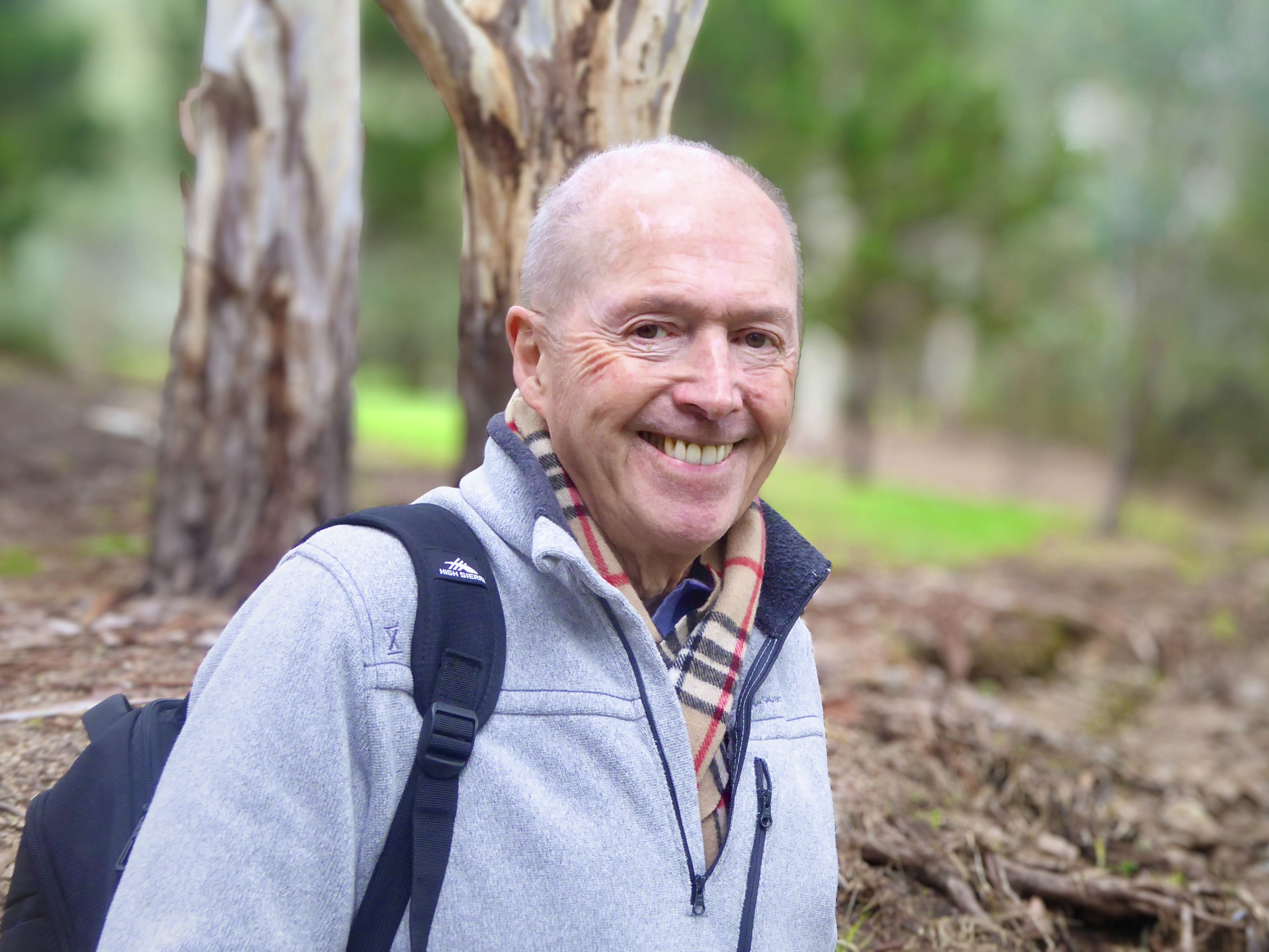
Michael Delahaye, journalist and former BBC correspondent, reflects on his 56-year career in international news and storytelling. (Image: Dallas Reynolds)
By Dallas Reynolds | @dallasolivia_
Michael Delahaye arrives prepared for an interview — just not in the way you might expect.
On the table in front of him sits a voice recorder, a laptop, and a black notebook.
Everything belongs to him.
It is the familiar toolkit of a long career spent in newsrooms, on assignments, in front of the camera as a reporter and correspondent, and behind the scenes as a documentary producer.
Today, the roles are reversed.
“It’s always interesting to have the tables turned. To find yourself answering rather than asking the questions,” he says over email. Delahaye joined the British Broadcasting Corporation in 1970 as a graduate news trainee in what he describes as a “guinea pig cohort,” beginning a 25-year career.
Since 1998, he has trained journalists with the Thomson Foundation, including work with Al Jazeera.
His reporting has taken him through elections, earthquakes, mass shootings and military takeovers.
His career has spanned 44 countries, four of which he has called home — the United Kingdom, France, Italy and Australia.
Looking back, Delahaye describes himself as “focused and impatient.”
“I always want to have a project,” he says.
“There’s nothing more boring in life than having nothing to do. If you haven’t got a next chapter in life … you might as well be dead.”
For eight years, he was a house husband.
He doesn’t claim to be a good cook, admits that shopping bores him, and says his wife, Anni, would likely confirm he is “not very good with the Hoover.”
He offers a wry self-portrait of how others might see him: “Rather full of himself, but he has a way with words and a fund of stories. All of which makes him good company in carefully measured doses.”
The humour is understated, but it points to something more consistent — a tendency to turn observation inward, as though applying a journalist’s eye to himself as readily as to others.
A week before this conversation, Delahaye’s notebook was in the breast pocket of his shirt during a university guest lecture, raising a simple question: what does it contain?
“Anything that comes up, to be honest,” he says.
“There are so many times when you’re talking to someone, and they say, ‘I’ve just read a really good book.’ If you don’t write it down straight away, it’s gone.”
He taps the notebook.
“It’s simple technology,” he says, “but it works.”
The practice sits alongside a longer discipline of record-keeping — including every email he has sent or received since the 1980s.
Delahaye smiles at what that might suggest.
“Probably that I’ve lost my memory.”
“We remember things, but we also think we remember them. That’s the difference. Thinking we remember is not good enough. Go back to the primary source.”
“Believe me, when it comes to writing, particularly non-fiction, [the notebook] is invaluable.”
He is the author of four commercially published works: After the Fall, The Sale of Lot 236, The Third Day, and Stalking Horse — and writes for newspapers and magazines in the United Kingdom and France.
He says writing rarely begins with a single idea.
“Writers let ideas marinate. There’s chemistry, percolating, and suddenly you see the juxtaposition. That’s where it happens. I think writers of fiction always have half a dozen ideas swirling. Then suddenly two connect.”
That instinct for attention predates his professional life.
Born in 1946, Delahaye grew up in England as an only child who, by his own description, was “very strange” — a boy who could lose himself in encyclopaedias for hours.
In his early twenties, he wrote to British institutes and teaching organisations in Italy. One — the British Institute in Florence — replied by telegram, asking whether he was available.
Rather than respond formally, he turned up on their doorstep three days later.
“They asked, ‘Do you speak Italian?’ I said, ‘No.’”
The institute offered Italian lessons alongside teaching work, and he learned on the job.
Living in Italy proved formative.
“There was something about Italy that intrigued me. And the Italian language is extraordinary.”
“I have a theory that you’re born with Italian. It’s as though there’s a sort of built-in chip in our brains. It just needs activating.”
Alongside teaching, he began drawing and painting.

At 23, Michael Delahaye sketches an image in Florence dubbed A Portrait of the Artist as a Young Man. (Image: Anni Delahaye)
His website holds a 45-year archive of European townscapes and landscapes.
“I’m an amateur in both senses of the word — a non-professional practitioner and a lover of the whole process,” he writes.
“I take up my pencils and brushes about once a decade, generally with great enthusiasm — only to abandon them in frustration until the memory of failure fades and I start again.”
He calls himself a “hobbyist”, drawn more to the satisfaction of process than outcome.
Photography follows the same instinct — a compact Sony Cyber-shot WX350 is on his hip.
“It’s like having a gun in a holster. I can take a photo within three seconds.”
“If something’s happening, those ten seconds it takes to get your phone out, steady and focus — you’ve missed it. It’s a visual diary.
“You think in words, but you’re always looking for visuals.”
Throughout his archive of photographs, one idea recurs: what he calls “symbolic shots” — moments that capture an entire story in seconds.
He reaches for an example.
At a Carrefour supermarket in Doha, Qatar, he noticed an aerosol spray starch-ironing product aimed at the Middle Eastern market.
Half the cans show a woman, described by Delahaye as “not in Arab dress, but Scandinavian-looking” — ironing with a staged ease, while the other cans show a man in traditional dress, smugly pleased with her work.
“You couldn’t get away with that in the UK or Australia,” he says. “People would say it’s sexist.”
“But that just struck me. I thought I would never see this illustration. And that was symbolic.”

The aerosol spray starch ironing product in Doha — the symbolic shot. (Image: Michael Delahaye)
Moments like that, he says, stay with him longer than formal reporting.
One of the proudest moments of his career comes not from a headline story, but from a former trainee.
In August 2007, a BBC Russian Service producer based in London’s Bush House placed a call to a television station in Novosibirsk, Siberia, following up on an unusual story about a woman living with 160 cats in her apartment.
At the end of the call, Elena, who had been trained by Michael Delahaye a few years earlier, asked the producer if he knew him.
The response was doubtful.
Given the BBC’s scale, it seemed improbable that such a personal connection would exist within such a large organisation. Then, from elsewhere in the office, another voice cut in.
A Georgian producer said she knew him too — he had trained her years earlier in Tbilisi.
Her name was Natia Abramia.
Of the many journalists Delahaye had trained over the years, Natia stands out.
She began her career in Georgia, then continued her studies in the United Kingdom, eventually joining the BBC Russian Service.
Over time, she established herself within international journalism, taking on increasingly senior roles.
Despite this, she has maintained a strong link to her native Georgia, regularly returning to train journalists there.
In doing so, she carries forward the same kind of guidance that once shaped her own career.
“In a very odd way, what I did all those years ago has developed into something,” Delahaye says.
“That gives me hope. I don’t like the word pride exactly — satisfaction, certainly. The seeds were planted.”
For younger journalists, his advice returns to curiosity.
“You can go through the motions, but you’ve got to want to find the answer before you give it to other people.”
“If you can tell people something new — or better still, something surprising — that’s a real bonus. Make them stop and think.”
“The world is an extraordinary place,” he says.
“And the more you get out, the more you ask, the more extraordinary you find it.
“Don’t expect luck to come to you. You have to put yourself in a place where it can happen.
“That’s the secret. The secret of life — and of journalism.”


Leave a Reply