
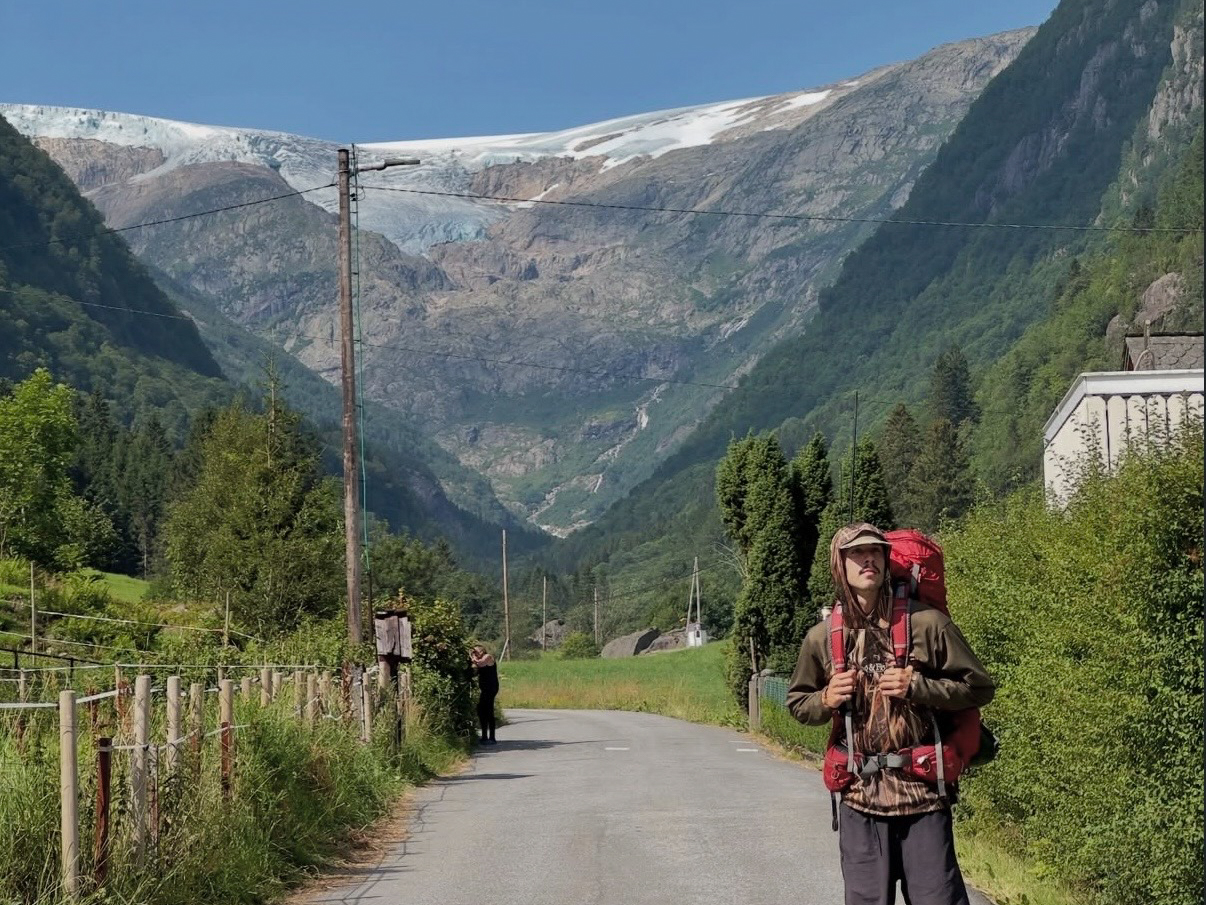
Lewis Pullman departed Adelaide with no itinerary, no set route, no timeline, only a sense of adventure and a mission to connect with others around the world. (Image: Lewis Pullman)
By Lucy Montgomerie | @lucymontgomerie
The backpacker graciously accepted the invitation extended to him.
It was somewhere to stay while spending time teaching English to locals in a Nepalese Buddhist monastery.
The home, belonging to a father and his two young sons, was a single room with one bed shared between the three of them.
The bed had no mattress, just a wooden bed frame.
There was no electricity.
Despite having two young boys to feed, the father offered the backpacker food and somewhere to stay.
The family, who had close to nothing, offered the backpacker everything.
This was one of many situations Lewis Pullman found himself in after departing Adelaide with no itinerary, no set route, no timeline, only a sense of adventure and a desire to connect with others around the world.

Lewis Pullman with local children at the Nala Gumba Dhagpo Sheydrub Ling Monastery. (Image: Lewis Pullman)
The 23-year-old grew up in a household supportive of his adventurous nature.
“I can’t complain at all, [my family] have given me every opportunity,” Pullman explains while sitting in a café in rural Meghalaya, India.
His voice is patchy and breaking up due to Meghalaya’s limited internet service.
A rooster crows in the background and local conversations flood the audio.
“India is noisy,” Pullman admits.
Pullman attended Urrbrae Agricultural High School which encouraged him to pursue an environmental career and supported his outdoor hobbies.
“Surfing, camping, fishing, martial arts, motorbikes, paragliding,” Pullman says.
“I love learning, exploring and experiencing. Experience is my hobby.”
Post-school, he worked in disability support and studied a Bachelor of Outdoor and Environmental Leadership at the University of South Australia.
The degree presented him the opportunity to study internationally in an exchange program at the University of Agder in Kristiansand, Norway.
“I realised so much was out there between Norway and Australia [and wondered] how could I experience it all,” Pullman says.
During this exchange, he experienced hitchhiking for the first time.
“One morning, I had missed the bus from Portugal to Spain and had no other option but to hitchhike,” Pullman recalls.
“It was a big challenge, but a very memorable day.”
One day, Pullman came up with an idea: hitchhike from the Arctic Circle to Australia, and as a result, Thumbprints was born.
Thumbprints is the name of Pullman’s mission to hitchhike from Tromsø, a Norwegian city 350km north of the Arctic Circle, all the way back home to Adelaide.
Rather than his journey being about navigating from A to B, Pullman says the goal is to embrace uncertainty, connect with people and share the stories as unique to them as their thumbprints.
His mission also aims to leave a positive imprint on the world.
“The main motive behind [Thumbprints] is to make the world a little bit closer,” Pullman says.
“I wanted to share a journey that was only possible with help from humanity.”
Departing Tromsø, Pullman made his way through Norway to Kristiansand, where he met his first real obstacle: the ocean.
Substituting his hitchhiking thumb for some posters, Pullman advertised his mission to the Norwegian public. He eventually caught the attention of a sailboat captain who invited him on board a festival boat called the Wylde Swan.
“He liked what I was doing and invited me on where I was getting three meals a day and got to sail around Europe for free,” Pullman says.

Pullman’s poster advertising Thumbprints (Image: Lewis Pullman)
However, Pullman quickly realised that going on a trip as chaotic as this was bound to result in hardship.
“I was trying to hitchhike 100 per cent of the way and I did for the first four months, but then I had a very rough month,” Pullman says.
“Not because of the people or anything, but because of a lot of factors in Turkey and Georgia.
“I tried to push but I got super sick and had food poisoning, meaning I wasn’t sleeping for weeks.”
Additionally, upcoming harsh winter conditions challenged his initial plans of travelling through Central Asia into China.
He had to decide whether to push hard to beat the winter, or to slow down and wait out the season.
“In the hard times, I looked at my option of calling it quits and pursuing the journey later,” Pullman says.
“But I changed up my journey by slowing down, volunteering and giving some purpose to what I was doing.”
Pullman chose to spend three months in Nepal, followed by another three months in India, which he believes “was the best decision”.
Relieving himself from stressors, Pullman remembered the true purpose of his adventure: connect with strangers and learn from their stories.
While based in India, Pullman got in conversation with a 20-year-old man in a restaurant.
“He was working 10 hours a day, seven days a week with two days off a month for the equivalent of $226 AUD per month,” Pullman says.
The man asked Pullman to return to the restaurant the next day.
“He had bought me a fridge magnet from the town I was in and a guidebook for the best places to see in the area,” Pullman says.
“All of the time I am experiencing good people.”
This is just one of the many interactions Pullman’s had which he says prove his belief that “humanity can be good; we can be good.”
However, Pullman’s journey has not been all butterflies and rainbows, and he admits he’s had some uncomfortable days and nights.
“But there is nothing to complain about because they are also the same circumstances literally millions of people around the world are living in,” Pullman says.
“If I have to experience it for a night, I can’t complain.”

Sleeping arrangements in Cappadocia, Turkey. (Image: Lewis Pullman)
Pullman also admits that he is not naïve to the flaws of humanity, citing experiences he’s had with people trying to scam him on his travels.
“It happens but you have to have perspective,” he says.
“If I was in [their] position and I had three kids at home, earned $2 [AUD] a day and saw a tourist with a huge backpack, would I be any different?”
Reflecting on his life in Adelaide prior to this adventure, Pullman says he misses the convenience of his small comforts, admitting he couldn’t remember the last time he’d used toilet paper.
He also acknowledges how isolating the experience has been, despite the hundreds of people he has met.
“It doesn’t mean [these interactions] are any less special but sometimes you want a familiar face,” Pullman says.
However, Pullman believes growth comes from “seek[ing] more out of life, jump[ing] out of your comfort zone and see[ing] what happens.”
Additionally, he deems if people go and experience the world firsthand it’s a step closer to breaking down the walls of division.
“At a ground level, people in each country, in each nation – we are not so different at all,” Pullman explains.
“At a fundamental level, [humans] are all seeking the same things beyond necessities.
“Everyone is seeking connection, community and purpose.”
Pullman actively shares his experiences to his 70,000 followers on his Instagram. He began his mission in July 2025 and returned to Adelaide in May.
At the time of interview, he had no plan as to where his next destination would be.
He only knew his goal for the day: travel to the nearest town, approximately three hours away.
“It is quite remote though, so we will see how I go,” Pullman says.
Later that day, Pullman shared a video to his Instagram account of him in a car with strangers at 3:56am in the morning.
Cold Chisel songs blast in the background while a driver Pullman describes as “questionably sober” drives him to his next destination.
Part of his caption reads: “Were there any other options?”
To which he answers: “no”.


Leave a Reply